A Thangka is a traditional Tibetan Buddhist scroll painting, typically depicting a deity, a mandala, or a symbolic scene, used historically for meditation and religious teaching rather than decoration. Every element - colour, posture, proportion - carries specific meaning, and master artists in Nepal often spend over a decade apprenticing before painting independently.
A workshop won't make you a Thangka painter. What it gives you is time in a real working studio, real natural pigments on your brush, and a master artist correcting your linework as you go - a far more direct connection to the craft than admiring finished pieces through a shop window in Thamel.
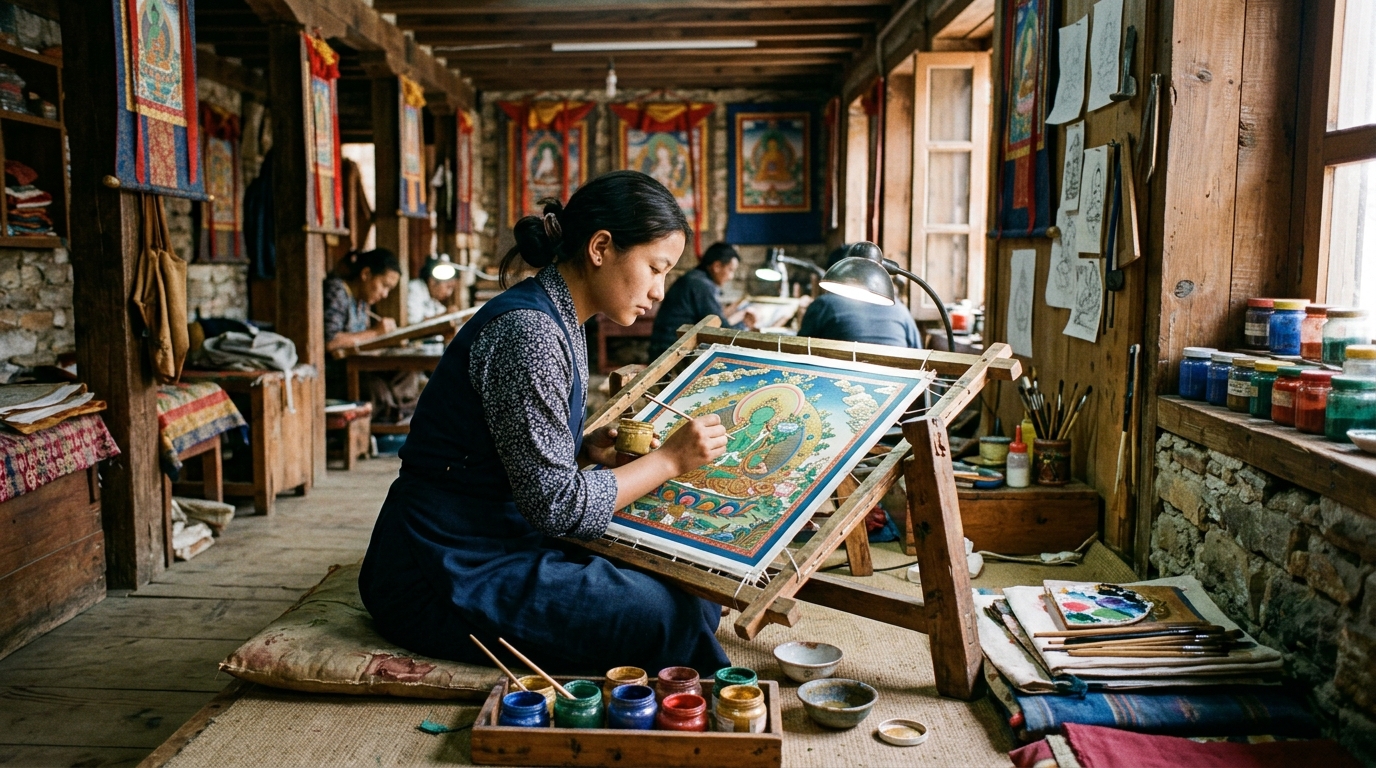
Thangka painting originates in Tibetan Buddhist monastic tradition and has been practiced in the Kathmandu Valley for centuries, closely tied to the valley's Newar Buddhist and Tibetan refugee communities. Higher-quality Thangkas use natural mineral pigments and sometimes 24-carat gold detailing, and are mounted in silk brocade frames once complete. Because the craft is so widely commercialised for tourists, quality in the shops varies enormously - one reason working directly with a genuine art school, rather than a retail gallery, gives a more honest picture of the tradition.
A typical workshop takes place in a functioning studio - you'll often see other students and working artists mid-piece around you, which is part of the value, since this is a real school rather than a space staged purely for visitors. Sessions usually begin with an explanation of Thangka symbolism and the philosophy behind it, then move into sketching and painting a small mandala or simple design under direct one-on-one guidance from a master artist.
You won't complete anything close to a full Thangka in an afternoon - serious students often extend their stay to 15 to 30 days for that. What you finish is a genuine, guided piece of your own that reflects real technique, not a pre-printed outline you simply colour in.
Most Kathmandu workshops run 4 to 5 hours with an afternoon start, priced around $70 to $75 per person. This typically includes hotel pickup and drop-off, all painting materials, and the finished piece to take home. A small number of operators offer a shorter, roughly one-hour orientation session focused more on explanation than painting - worth knowing if your interest is cultural context rather than a full hands-on session.
Thamel has the highest concentration of workshops set up for a single afternoon session, convenient if you're staying centrally in Kathmandu. Patan, historically one of the valley's key artisan centres, also has respected Thangka studios. For a more immersive setting, some schools operate above Bhaktapur near Changunarayan, a UNESCO-listed hilltop site with views over the Kathmandu Valley - worth considering if you'd rather combine the art lesson with a quieter, more scenic setting than central Kathmandu.
If a single session leaves you wanting more, several schools accommodate extended study - anywhere from a few additional days to a full month for travellers serious about learning the craft properly. This isn't something every operator advertises upfront, so it's worth asking directly when you book whether extending your training is possible and what it costs beyond the standard single-session price.
If your Thangka workshop is in Bhaktapur or Patan rather than Thamel, it combines naturally with pottery making in Bhaktapur or a stone carving workshop in Patan, since all sit within the same compact heritage cities.
Do I need any painting experience for a Thangka workshop?
No. Workshops are designed for complete beginners and the master artist guides you through the technique step by step. Patience and a steady hand help more than prior art experience.
How long does it take to properly learn Thangka painting?
A single afternoon workshop gives you a genuine introduction and a small finished piece, but real proficiency takes years of apprenticeship. Some travellers extend their stay to 15-30 days of daily lessons for a deeper grounding in the technique.
What's included in the workshop price?
Most Kathmandu workshops at around $70-75 include all materials, hotel pickup and drop-off, direct instruction from a master artist, and your finished painting to take home.
Is the finished painting a real Thangka I can hang or use for meditation?
Your finished piece is a genuine hand-painted piece using traditional techniques and pigments, but as a first attempt under guidance it's best thought of as a meaningful personal souvenir rather than a ritual-grade Thangka, which typically takes a trained artist far longer to complete.
Tell us your travel dates and group size. We'll confirm availability with a trusted local artisan and build it into your Kathmandu Valley itinerary.

Getaway Nepal Adventure (P.) Ltd.
Thamel Kathmandu, Nepal
Tel: +977 98510 38 908





 TripAdvisor