Kathmandu's old city is built around bahals and bahils - Newari Buddhist courtyard complexes, usually reached through a low, easy-to-miss doorway set into a row of ordinary shopfronts. Step through one and the noise of the street disappears almost immediately: you're standing in a quiet square lined with stupas, prayer wheels and carved wooden windows, often with laundry drying between them, because most of these courtyards are still lived in rather than preserved as museum pieces.
None of them charge entry, none require a guide, and the vast majority of visitors to Kathmandu never step through one of these doorways at all. This is the lowest-cost, most flexible experience on this list - and one of the most rewarding if you're willing to walk slowly and look for unmarked entrances.
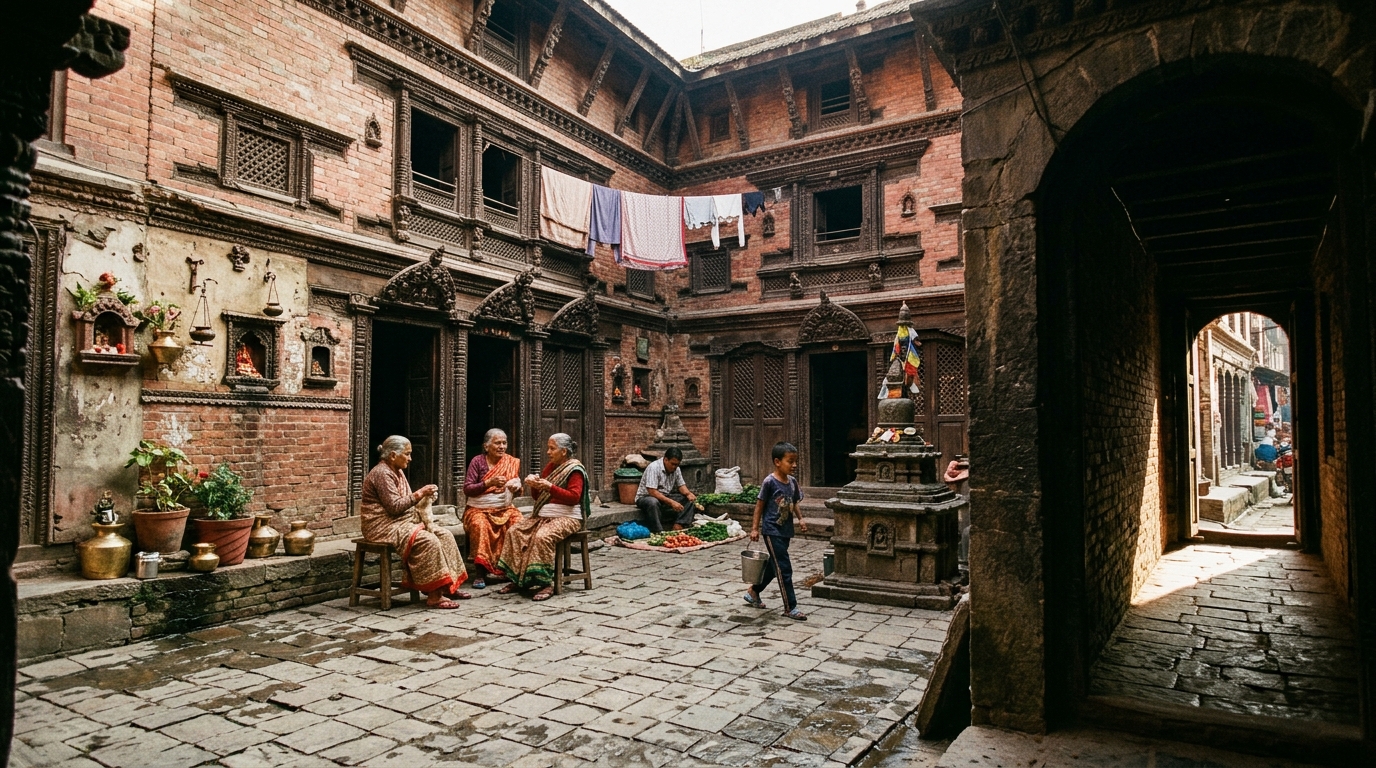
A bahal (or the smaller bahil) is a traditional Newari courtyard, historically a Buddhist monastic complex, built as an enclosed square surrounded by residential buildings with a stupa or shrine at its centre. Itum Bahal, the largest in the city, sits only a few minutes' walk from Kathmandu Durbar Square yet is missed by most travellers who stick to the main tourist route between Thamel and Durbar Square. Dozens of smaller bahals and bahils - Yetkha Bahal, Takse Baha, Musya Bahal, Kwathu Baha among them - are scattered through the same few square kilometres of the old city.
The reason they're missed is architectural, not accidental: entrances are deliberately unassuming, often just a narrow, low doorway between two ordinary shops, giving no hint of the open square inside.
A good walking route links Thahiti Stupa near southern Thamel, through Ason Bazaar - Kathmandu's oldest and busiest market, still selling spices, textiles and daily goods much as it has for centuries - on to Indra Chowk, a historic trading junction known for glass bead and fabric shops, and finishes at Kathmandu Durbar Square. Along the way, detour through as many unmarked courtyard doorways as you're willing to investigate; getting slightly lost in the old city's lanes is part of the appeal rather than a problem to avoid.
Early morning or a Saturday (Nepal's weekly day off) are noticeably quieter, with less traffic and fewer crowds in Ason Bazaar, and a stronger sense of the old city's daily rhythm rather than its tourist-hour version. Morning light is also better for photography inside the courtyards themselves, many of which are narrow and shaded for most of the day.
Because none of the courtyards charge entry, this is one of the few experiences on this list that works well entirely self-guided with a decent map - most travellers can navigate the core route (Thahiti, Ason, Indra Chowk, Durbar Square) without difficulty. A guided version, typically 2.5 to 3 hours and either free or paid ($15-50), adds historical and religious context you'd otherwise miss - what a particular shrine represents, why a courtyard sits where it does, which buildings survived the 2015 earthquake and which didn't. If you're interested in the history rather than just the atmosphere, a guide is worth the cost; if you mainly want a quiet walk away from the main sights, self-guided works fine.
This walk connects naturally with a rickshaw ride through old Kathmandu, since both cover overlapping ground around Ason and Durbar Square - do the walking tour first to find the courtyards on foot, then a rickshaw ride afterward to cover more distance at a slower pace than walking allows. It also pairs well with a cooking class to end the day, since most classes run from bases in or near Thamel.
Is it safe to explore Kathmandu's hidden courtyards on your own?
Generally yes. These are residential and religious spaces used daily by local families, not isolated or abandoned areas. Standard city-travel awareness applies, and it's respectful to be quiet and unobtrusive since people live and worship in these courtyards.
Do the hidden courtyards charge an entry fee?
No. Bahals and bahils are open, lived-in community spaces with no entry charge, unlike ticketed sites such as Durbar Square or Swayambhunath.
How long does a hidden courtyards walking tour take?
A guided route typically runs 2.5 to 3 hours. Self-guided, it depends entirely on how many courtyards you stop to explore - budget at least 2 hours for a satisfying walk without rushing.
What's the best time of day to do this walk?
Early morning or on a Saturday, when the old city's lanes and markets are quieter and the light inside the courtyards is better for photography.
Tell us your travel dates and group size. We'll confirm availability with a trusted local artisan and build it into your Kathmandu Valley itinerary.

Getaway Nepal Adventure (P.) Ltd.
Thamel Kathmandu, Nepal
Tel: +977 98510 38 908





 TripAdvisor