Walk through Thamel and you will pass a khukuri in nearly every souvenir shop window: the curved blade carried by Gurkha soldiers, hill-tribe farmers, and Nepali households for generations. Most of what's on those shelves was mass-produced somewhere else and shipped in. A genuine khukuri making experience puts you inside an actual working forge, hammer in hand, next to a blacksmith who has been doing this since before you were born.
This is one of the most requested cultural workshops in Kathmandu, and for good reason: you leave with a real object, not a photo. But the quality of the experience depends entirely on which workshop you book, so this guide covers what actually happens, what it costs, and how to tell a serious forge from a rushed demonstration built for tour groups.
What Is a Khukuri, and Why It Matters
Inside the Forge: What Happens
Duration, Price and What's Included
The khukuri is Nepal's national blade: a forward-curving knife used as a tool, a weapon, and a ceremonial object, most famously carried by Gurkha regiments. The small notch near the handle, called the cho, is traditionally read as a symbol of the Hindu trinity of Brahma, Vishnu and Shiva, and also serves a practical purpose in stopping blood from running onto the handle. Beyond its military reputation, it's an everyday tool in the hills of Nepal, used for everything from clearing brush to preparing food.
Because it carries so much cultural weight, learning to forge one - even the small, guided part a beginner can safely handle - is a genuinely different experience from buying one off a shelf.
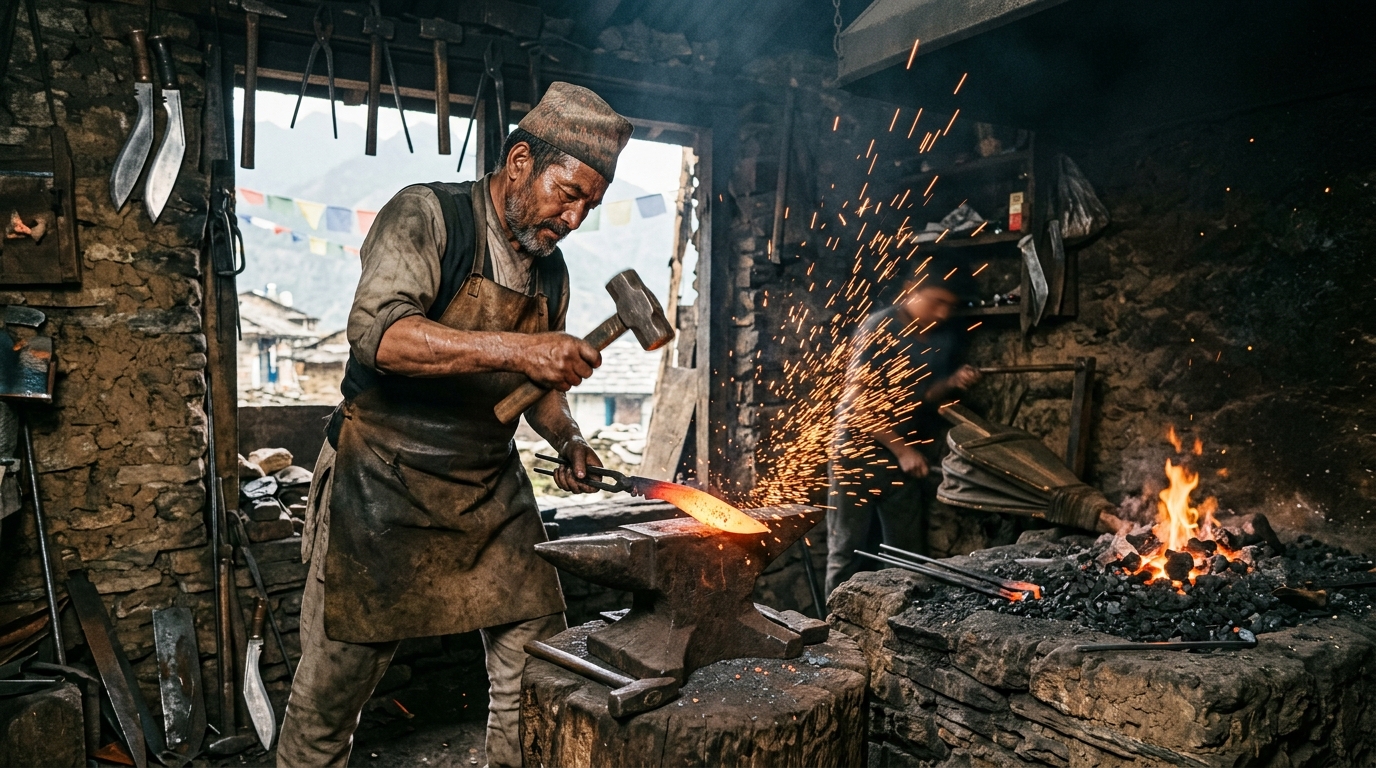
A typical session starts with a short introduction to the history and symbolism of the khukuri, usually over tea, before you're brought to the anvil. The blacksmith heats a steel blank in a coal or wood-fired hearth until it glows orange, then guides you through hammering it into shape. You won't be left alone with a hot blade: an experienced smith works alongside you, handling the technical steps that require real skill - achieving the correct curve, tempering the steel - while you do the parts a beginner can manage safely, typically hammering, grinding the edge, and shaping the handle.
Toward the end of the session the blade is ground, polished, and often fitted into a handcrafted wooden handle with a leather or wood scabbard. Many workshops let you have your name or a short inscription added, which turns the finished knife into a genuinely personal souvenir rather than a generic one.
Expect a session of around 4 to 5 hours, most of it active hands-on time at the forge rather than sitting and watching. Group sizes are kept deliberately small - typically capped at 4 to 5 people - so that everyone actually gets time at the anvil instead of watching someone else hammer.
Pricing across Kathmandu workshops generally runs $65 to $90 per person. Better-reviewed operators include hotel pickup and drop-off, tea and light snacks during the session, and the finished knife with its scabbard to take home. A few also include lunch. Always check whether the price includes your finished knife - a small number of budget operators charge extra for you to keep what you made, which defeats the point of the experience.
The best khukuri workshops happen in an actual working forge - often a small, family-run operation, sometimes with a son or apprentice working alongside the main blacksmith - rather than a space set up purely for visitors. Ask, before booking, whether you'll be working with the lead blacksmith directly and whether the forge produces khukuris for sale outside of tourist workshops. A shop that only exists to run demonstrations for travellers is a different, generally lower-quality experience than a working forge that occasionally opens its doors.
Group size is the other reliable signal. If an operator won't confirm a maximum group size before you book, assume it will be larger than you'd like and that your actual hands-on time at the anvil will be short.
The khukuri workshop is a strong standalone half-day, best not rushed alongside other bookings on the same day. If you want to build a full artisan day around it, pair it with a hidden courtyards walking tour of Kathmandu's old city in the morning, since both are based in or near Thamel and the old town, then the forging session in the afternoon once you've had lunch.
Is the khukuri making experience safe for beginners?
Yes. You work alongside an experienced blacksmith who handles the highest-risk steps - moving hot steel and tempering the blade - while guiding you through the safer hands-on parts like hammering and grinding. No prior experience is needed and workshops welcome complete beginners.
Can I take the knife home on a flight?
A finished khukuri is a checked-baggage item, not carry-on, under standard international airline security rules. Most workshops provide a sheathed knife specifically so it can be safely packed. If you're continuing to other countries afterward, check that country's import rules for knives before you travel.
How much does a khukuri making workshop cost in Kathmandu?
Most reputable workshops charge $65 to $90 per person for a 4 to 5 hour session, including materials, the finished knife, and usually hotel transfers. Prices below this range often mean less hands-on time or a shared, rushed group session.
Do I need to book in advance?
Yes. Because group sizes are kept small and forges have limited daily capacity, booking a day or two ahead is recommended, especially in the high season between September and November and March to April.
Tell us your travel dates and group size. We'll confirm availability with a trusted local artisan and build it into your Kathmandu Valley itinerary.

Getaway Nepal Adventure (P.) Ltd.
Thamel Kathmandu, Nepal
Tel: +977 98510 38 908





 TripAdvisor