Pottery Square, known locally as Bolachhen Tol, sits a short walk from Bhaktapur Durbar Square. It is not a museum exhibit or a staged demonstration - it's a working neighbourhood where the Prajapati community has thrown, dried, and fired clay pots in the open square for generations. Hundreds of finished pieces sit drying in the sun at any given time, and potters work at heavy wooden wheels spun by hand with a bamboo stick, the same method used here for centuries.
You don't need a booking to see it, and you don't need much time to try it. This guide covers both the five-minute version anyone can do on a whim, and the longer, more structured lesson for travellers who want to actually learn the technique.
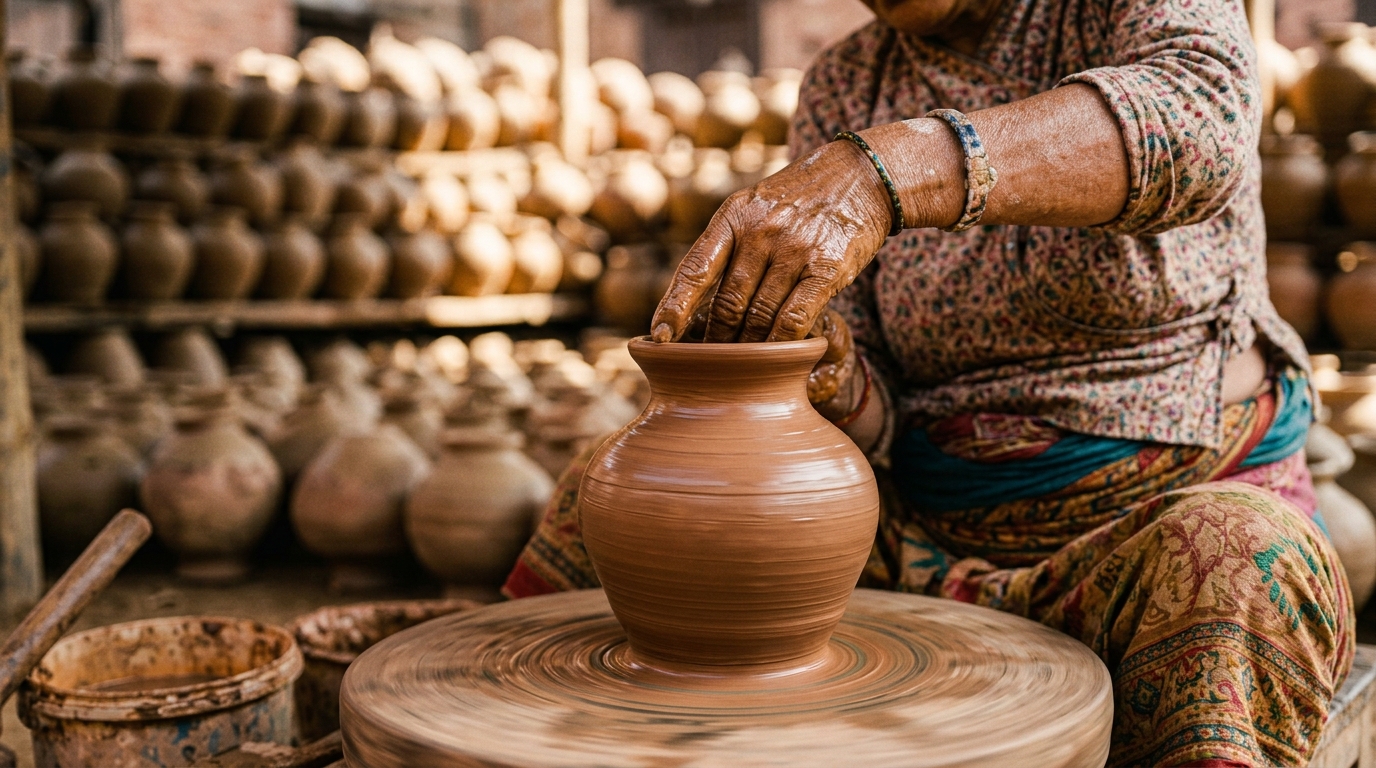
The casual version is what most visitors end up doing, often without planning it: sit down with a potter for five to ten minutes and shape a simple cup, mug, or small pot. It costs next to nothing, usually NPR 100 to 150 (roughly $1 to $1.50), and works well as a spontaneous stop rather than something you need to arrange ahead of time.
The structured version is an actual lesson, typically an hour with a potter who talks you through centring the clay, controlling the wheel speed, and shaping properly - not just guiding your hands through it. This runs NPR 1,200 to 2,800 (about $9 to $21) depending on whether you want your finished piece properly fired and prepared for travel rather than just air-dried. Some operators package this lesson together with a guided walking tour of Bhaktapur Durbar Square for $40 to $70, which adds historical context to the city around the pottery.
What makes Pottery Square worth building time around, rather than treating as a five-minute photo stop, is that the entire visible process is happening in front of you at once: clay being dug and prepared, pots being thrown, finished pieces drying in the sun in their hundreds, and a kiln firing nearby. Most potters working the square are used to visitors and happy to have you sit down, though English fluency varies - simple gestures and demonstration usually communicate the technique fine.
Morning light is best for photography and the square is generally quieter earlier in the day, before Bhaktapur's main tourist flow picks up around mid-morning.
Entry to Bhaktapur's historic core - which covers Durbar Square, Pottery Square, Taumadhi Square and Dattatreya Square - requires a foreigner heritage ticket, currently around NPR 1,500 to 1,800 (roughly $15). This is a one-time entry fee for the city, not a separate charge for Pottery Square itself; once you're inside, trying the wheel or buying pottery has no additional entry cost beyond what you pay the potter directly for the session.
Bhaktapur is compact enough to build a full craft day around. Pottery Square sits close to workshops offering Lokta paper making, and several Thangka schools operate in and around the city as well - see our Thangka painting workshop guide. A single day covering pottery, paper making, and a Durbar Square walking tour is a realistic and popular combination.
Do I need to book pottery making in Bhaktapur in advance?
No, for the casual five-to-ten-minute version - you can simply walk up to Pottery Square and sit down with a potter. For a longer, structured hour-long lesson, or a package that includes firing and shipping your piece, booking a day ahead is worthwhile so the right potter is available.
How much does pottery making in Bhaktapur cost?
A quick five-minute session costs roughly NPR 100-150 ($1-1.50). A full hour-long lesson runs NPR 1,200-2,800 ($9-21). Combined packages with a Durbar Square guided tour run $40-70.
Can I take my finished pottery home?
Air-dried pieces made in a quick session are fragile and best left as an experience rather than a souvenir to pack. If you want to take something home, ask specifically for a piece that will be properly fired - this usually needs to be arranged through the longer lesson, since firing and drying take time beyond a same-day visit.
Is there an entry fee just for Pottery Square?
No separate fee. Pottery Square is included within Bhaktapur's general foreigner heritage ticket (around NPR 1,500-1,800), which covers the whole historic city.
Tell us your travel dates and group size. We'll confirm availability with a trusted local artisan and build it into your Kathmandu Valley itinerary.

Getaway Nepal Adventure (P.) Ltd.
Thamel Kathmandu, Nepal
Tel: +977 98510 38 908





 TripAdvisor