Nepal's mountains get most of the attention, but its rivers carry an equally compelling story. Every major waterway in the country begins life as Himalayan snowmelt or glacial runoff, gathers force as it drops through some of the steepest terrain on the planet, and arrives in the lowlands as a force genuinely worth respecting. The result is one of the world's great rafting destinations: a country with rivers graded from gentle Class II floats suitable for total beginners to committing Class V whitewater that demands real skill and nerve.
What sets Nepal apart from other rafting destinations is the variety packed into a small geographic area. The Trishuli River offers an easy half-day or full-day trip squeezed between Kathmandu, Pokhara, and Chitwan. The Bhote Koshi delivers one of the most intense short whitewater experiences in the world barely three hours from the capital. The Kali Gandaki carves through the deepest gorge on earth, between the Annapurna and Dhaulagiri massifs, combining serious rapids with extraordinary mountain scenery. Whichever river you choose, you will pass through terraced hillsides, riverside villages, and landscapes that few travellers see from any other vantage point.
This guide breaks down Nepal's main rafting rivers, compares their difficulty and character, and helps you choose the right trip for your time, budget, and appetite for adrenaline.
Trishuli River - The Accessible Classic
Bhote Koshi River - The Adrenaline Short Trip
Seti River - Gentle and Scenic
Kali Gandaki River - Gorge and Grandeur
Multi-Day Expeditions: Sun Koshi and Karnali
Every raftable river in Nepal is rated on the international whitewater scale of Class I to VI, and understanding this scale is the single most useful thing you can do before choosing a trip. Class I and II rapids are gentle, with small waves and few obstacles, ideal for total beginners and families. Class III introduces moderate, irregular waves and requires some manoeuvring but remains accessible to first-time rafters with a good guide. Class IV brings powerful, continuous rapids with significant drops, demanding good fitness and ideally some prior rafting experience. Class V is the domain of serious whitewater enthusiasts, with violent, continuous, and unpredictable rapids that carry real consequence if something goes wrong.
Most of Nepal's popular rivers offer a mix of grades along a single run, and water levels shift the difficulty significantly by season; a river that sits at Class III in low water can climb to Class IV or V during peak monsoon flow. Reputable operators always assess current conditions before grading a specific departure, which is why it pays to book with an established company that monitors river levels closely.
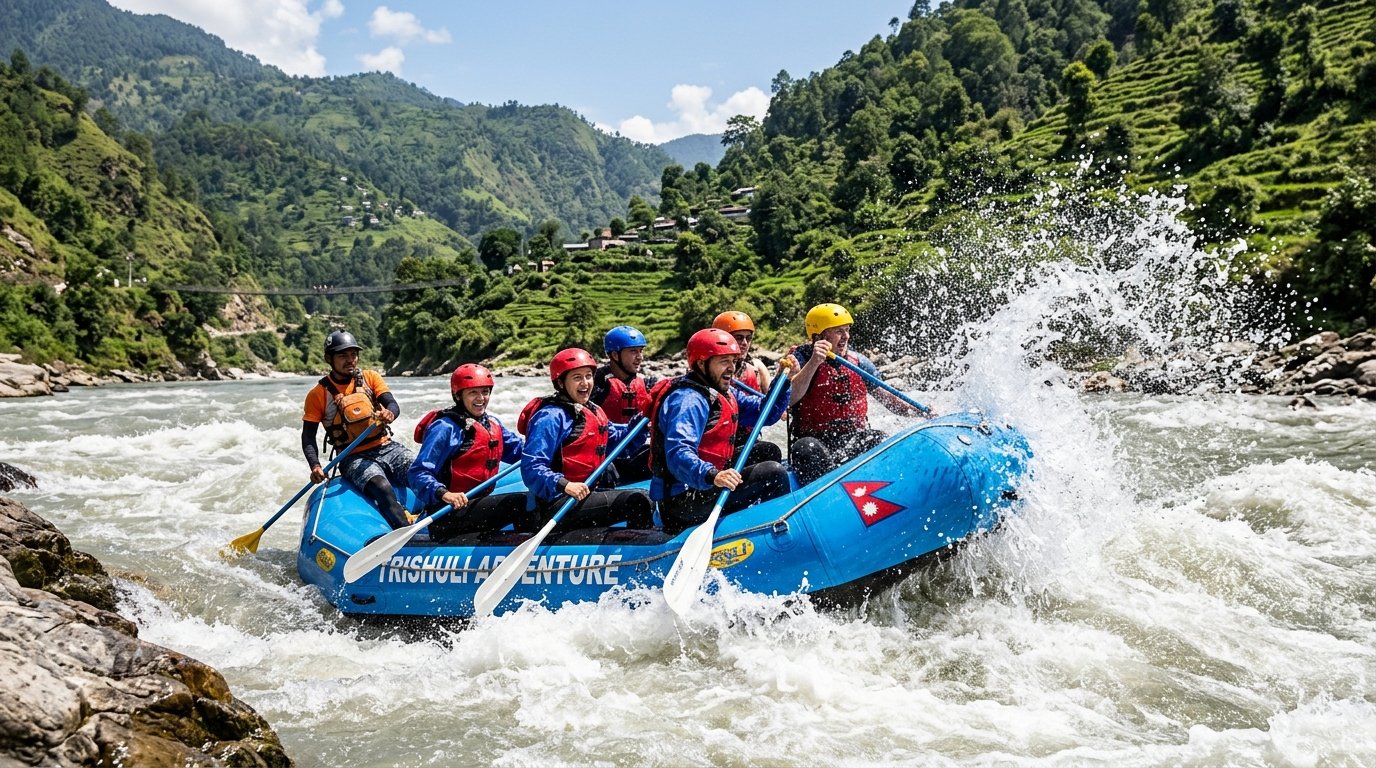
The Trishuli is Nepal's most popular and most accessible whitewater river, and for good reason. It runs roughly parallel to the highway connecting Kathmandu, Pokhara, and Chitwan, which means it slots naturally into almost any itinerary as a half-day or full-day stop rather than a dedicated excursion. Rapids here sit mostly in the Class II to III range, named sections like Snail's Nose and Malekhu offering genuine excitement without tipping into territory that requires prior experience.
Between the rapids, long calm stretches give paddlers time to float, swim, and take in the scenery of terraced hillsides and small riverside villages along the bank. Because the Trishuli is rafted nearly year-round, including the higher water levels of monsoon season, it works as a flexible add-on regardless of when your Nepal trip falls. It is the ideal choice for beginners, families with older children, and travellers who want a genuine adventure experience without the longer time commitment of a multi-day river journey.
If the Trishuli is Nepal's friendly introduction to rafting, the Bhote Koshi is the country's most intense short whitewater run. Originating on the Tibetan plateau (bhot means Tibet in Nepali) and roaring down toward the border roughly three to four hours from Kathmandu, this river is the steepest commercially rafted waterway in Nepal, delivering continuous Class III to V rapids depending on the season and water level. There is little time to admire the scenery once the action starts; this is a full-on commitment from the first rapid to the last.
The Bhote Koshi is best suited to rafters with some prior experience or a genuine appetite for adrenaline, and trips typically run as a one or two-day package. Because the put-in point sits close to the Nepal-Tibet border near Kodari, the same region where Nepal's original bungee jumping site operates, many travellers combine a Bhote Koshi rafting trip with a jump at The Last Resort for one of the most concentrated adrenaline days available anywhere in the country. See our full bungee jumping in Nepal guide for details on combining the two.
The Seti River offers a different character entirely: warm water, relatively small volume, and a gentle, picturesque run that makes it one of the best choices for beginners, families, and anyone who wants a more relaxed introduction to rafting alongside genuinely beautiful scenery. Rising on the slopes of the sacred Machhapuchhre (Fishtail) mountain near Pokhara, the Seti flows south through a landscape of forests, farmland, and small villages, with rapids that rarely exceed Class II to III.
Trips on the Seti typically run one to two days and are easy to combine with a Pokhara-based itinerary, making this a natural pairing with paragliding or a short Annapurna trek. For travellers who want the experience of being on a Himalayan river without the commitment of intense whitewater, the Seti delivers exactly that.
Named for the fierce Hindu goddess Kali, the Kali Gandaki carves its way through what is technically the deepest gorge on earth, measured between the summits of Annapurna and Dhaulagiri on either side. This is rafting with genuine geological drama: towering rock walls, cascading waterfalls, and upstream views of two 8,000-metre peaks combine with a solid run of Class III and IV rapids, with the occasional IV+ section depending on water levels.
Most Kali Gandaki trips run two to three days, starting from Maldhunga and finishing around Mirmi, both a few hours from Pokhara by road. Along the way, rafters pass ancient Hindu cremation ghats, remote villages belonging to several of Nepal's main ethnic groups, and beach campsites that make for memorable overnight stops. This river suits intermediate to experienced rafters looking for a multi-day journey that combines serious whitewater with serious scenery, and it pairs naturally with an Upper Mustang or Annapurna itinerary given its proximity to the trekking routes there.
For travellers with more time and a serious appetite for river adventure, Nepal's two great multi-day expeditions are the Sun Koshi and the Karnali. The Sun Koshi has been rated by National Geographic as one of the ten best river journeys in the world, running up to eight days from the Tibetan border down to its confluence with the Ganges system, through a constantly shifting mix of calm stretches and powerful Class III to V rapids, remote gorges, and riverside camps with no road access at all.
The Karnali, Nepal's longest and largest river, springs from the sacred Mount Kailash region of Tibet and offers an equally epic ten-day wilderness journey through the country's far west, an area few travellers ever see by any other means. Both expeditions are genuine adventures rather than day trips, suited to rafters who want total immersion in Nepal's remote river landscapes, accompanied throughout by experienced guides, safety kayakers, and full camping support.
| River | Grade | Duration | Indicative Cost |
|---|---|---|---|
| Trishuli | Class II-III | 1-2 days | USD 40-100 |
| Bhote Koshi | Class III-V | 1-2 days | USD 40-100 |
| Seti | Class II-III | 1-2 days | USD 70-150 |
| Kali Gandaki | Class III-IV | 2-3 days | USD 70-150 |
| Sun Koshi | Class III-V | 7-10 days | USD 400-800 |
| Karnali | Class III-V | 8-10 days | USD 400-800 |
Prices typically include transport, certified guides, safety equipment, meals, and camping gear on multi-day trips; international flights and personal expenses are not included. The most favourable rafting conditions across nearly all rivers fall in October and November, just after the monsoon when water levels are high but manageable, and again from March to May before the pre-monsoon heat builds. The Trishuli remains raftable nearly year-round, including during the monsoon, when its swollen waters add an extra layer of excitement for those seeking it.
Rafting fits naturally into almost any Nepal itinerary because the main rivers sit directly on the route between the country's key destinations. A Trishuli rafting stop is an easy half-day addition to the drive between Kathmandu and Pokhara or Chitwan, while the Bhote Koshi pairs perfectly with a day at the bungee jumping site near the Tibet border. See our full bungee jumping in Nepal guide for combined packages.
For travellers based in Pokhara, a morning of paragliding above Sarangkot and an afternoon on the Seti River make for one of the most varied adventure days available anywhere in the country; see our paragliding in Pokhara guide for details. After a day on the water, sore shoulders and tired muscles respond well to a proper massage; our guides to the best massage spas in Kathmandu and best massage spas in Pokhara cover exactly where to recover. Rafting also combines naturally with a wildlife safari in Chitwan National Park, since the Trishuli's lower stretches flow close to the park boundary.
Which is the best river for white water rafting in Nepal?
It depends on your experience and time available. The Trishuli is the most accessible and best for beginners with Class II to III rapids. The Bhote Koshi offers the most intense short trip with Class III to V rapids. The Kali Gandaki and Seti rivers balance scenic beauty with moderate rapids for a multi-day experience.
What is the best time of year for rafting in Nepal?
September to November and March to May offer the most favourable water levels and stable weather. October and November in particular deliver the most reliable combination of clear conditions and good rapids on nearly all major rivers.
How much does white water rafting cost in Nepal?
A day trip on the Trishuli or Bhote Koshi typically costs USD 40 to 100 per person. Multi-day trips on the Seti or Kali Gandaki cost USD 70 to 150 per person, while long expeditions on the Sun Koshi or Karnali range from USD 400 to 800 per person.
Do I need previous rafting experience?
No prior experience is necessary for rivers with milder rapids like the Trishuli and Seti. Rivers with more intense rapids, such as the Bhote Koshi and Marshyangdi, are better suited to rafters with good fitness and ideally some previous experience.
Tell us your travel dates, group size, fitness level, and what you are looking for. We respond within 24 hours with availability and a tailored itinerary.

Getaway Nepal Adventure (P.) Ltd.
Thamel Kathmandu, Nepal
Tel: +977 98510 38 908





 TripAdvisor