Most bungee jumps in the world happen off a crane in a car park or a purpose-built tower beside a motorway. Nepal does it differently. Here, the jump happens off a steel suspension bridge slung across a genuine Himalayan gorge, with a wild glacial river roaring 160 metres below and dense forest climbing the cliff walls on either side. There is no artificial structure standing in for nature; the gorge is the real thing, carved by the Bhote Koshi River as it crashes down from the Tibetan plateau toward the Nepal border.
This is The Last Resort, Nepal's original and most iconic bungee jumping site, and it remains one of the most spectacular places in the world to take the leap. Designed by one of New Zealand's leading bungee specialists and operated to international safety standards for more than two decades, the jump combines genuine technical credibility with a setting that few other bungee sites anywhere can match. Beyond The Last Resort, Nepal now offers two other notable bungee experiences: the record-breaking 228-metre Kushma Bungee in western Nepal, and the more approachable Hemja tower bungee just outside Pokhara.
This guide covers everything you need to know about jumping in Nepal, from cost and safety to exactly what the experience involves.
The Last Resort - Nepal's Original Bungee Site
What the Jump Actually Involves
Cost of Bungee Jumping in Nepal
Safety Standards and Health Requirements
The Last Resort sits roughly 100 to 110 kilometres east of Kathmandu along the Araniko Highway, the road that eventually crosses the Friendship Bridge into Tibet, in the Sindhupalchok district near the Nepal-China border. The drive takes around three to four hours and is itself a scenic introduction to the day, climbing through terraced hillsides and following the Bhote Koshi River as it tumbles down from the high plateau through the Gaurishankar Conservation Area.
The resort itself is built on terraced slopes above the gorge, with safari-style tents set among gardens and forest, and has operated continuously since 1998, making it one of the longest-established adventure sites in Nepal. The jump takes place from a purpose-built 166-metre-wide steel suspension bridge spanning the gorge, the first privately owned bridge of its kind in the country, engineered to a 4x safety factor under Swiss measurement standards with a loading capacity well in excess of 40 tonnes. At 160 metres, the drop ranks among the top ten highest bungee jumps in the world and remains Nepal's signature adventure experience.
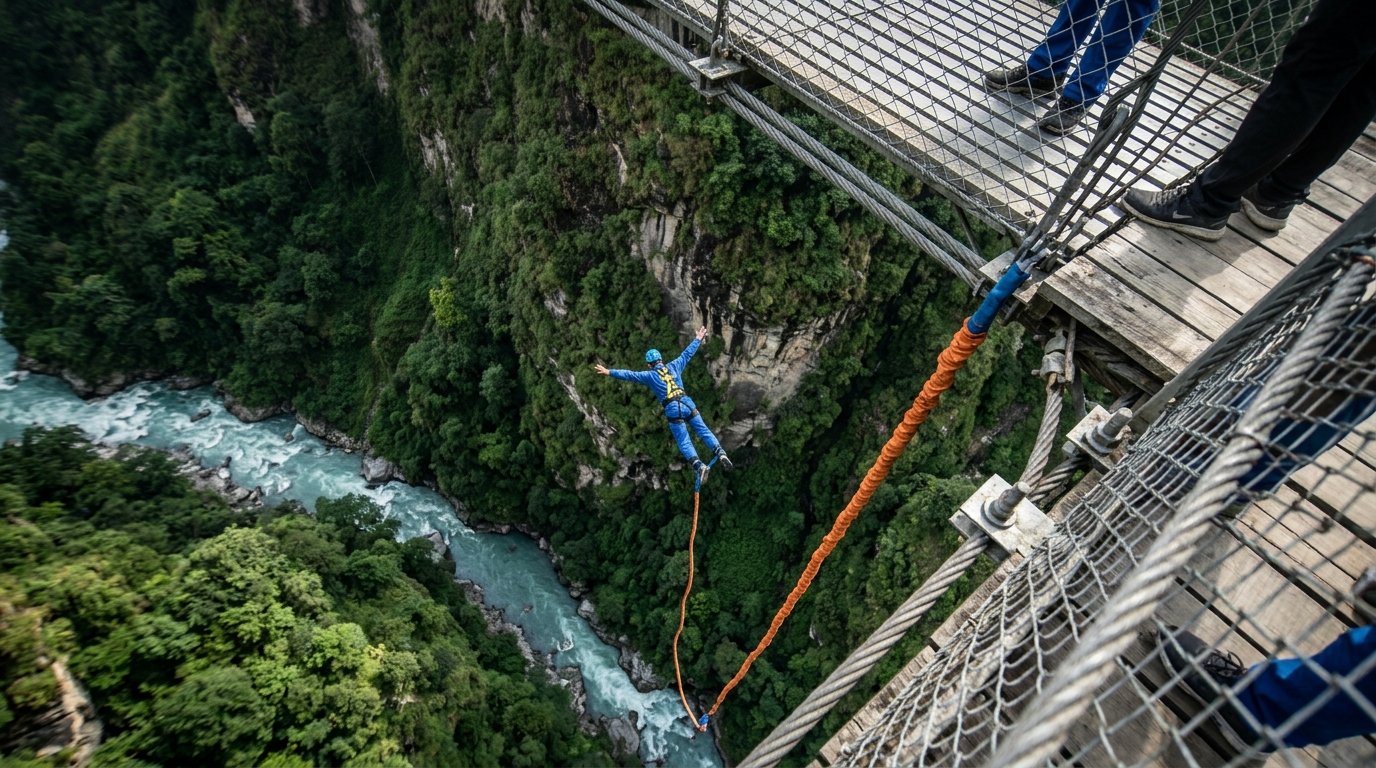
After arriving at the resort and completing registration, jumpers receive a safety briefing and have their harness fitted by trained jump masters. Standing on the steel bridge above the gorge, you can hear the river roaring far below and feel the cool air rising from the forest on either side; this build-up is, for many jumpers, more intense than the jump itself.
Once the countdown finishes, there is no easing into it. The freefall toward the river lasts only a few seconds but feels considerably longer, before the cord catches and recoils, sending you bouncing back upward in a sequence of decreasing arcs until the rope team lowers you safely to a platform. Many first-time jumpers describe the seconds in freefall as the most purely intense moment of their entire Nepal trip. For those who want more, The Last Resort also offers a Canyon Swing, a pendulum-style jump over the same gorge that gives a longer airtime experience many jumpers find even more intimidating than the bungee itself.
Personal phones and cameras are generally not permitted during the jump for safety reasons, though some operators allow a staff-secured GoPro on request, and professional photo and video packages are available to purchase as a memento of the moment.
A single jump at The Last Resort typically costs in the region of USD 90 to 140 per person, which includes the safety briefing, all equipment, and a certificate confirming your jump. A second jump on the same day is usually offered at a reduced rate for those who want to do it again immediately, since the adrenaline rarely fades fast. Combo packages that pair the bungee with the Canyon Swing, white water rafting, or an overnight stay typically run from USD 150 to 200, and these combinations tend to offer better overall value than booking each activity separately.
Day trip packages that include private transport from Kathmandu and lunch generally cost around USD 150 to 170 in total. Most operators also offer overnight packages at The Last Resort itself, allowing you to combine the jump with a relaxed evening in the gorge-side setting and a second day of rafting on the Bhote Koshi before returning to Kathmandu.
Kushma Bungee. Located in western Nepal over the Kali Gandaki River gorge, the Kushma Bungee stands at 228 metres, making it the highest bungee jump in the country and one of the highest in Asia. This is a serious undertaking that typically requires a full day's commitment and advance booking, recommended for jumpers who have already done The Last Resort and want to go further.
Hemja Bungee, Pokhara. For travellers based in Pokhara who want a bungee experience without the long drive to the Tibet border, the Hemja tower bungee near Lakeside offers a 70-metre jump just twenty minutes from town. It is a tower-based jump rather than a natural gorge crossing, making it a gentler introduction to the sport and a popular choice for first-timers who are nervous about committing to the full Bhote Koshi height. It is also recognised as one of the highest water-touch bungee jumps in the world, with some packages offering a brief skim of the water at the bottom of the fall.
Bungee jumping in Nepal has built its reputation on rigorous, internationally consulted safety engineering rather than improvisation. The Last Resort bridge was designed by a leading New Zealand bungee specialist and is operated by trained jump masters working to exacting international standards, with equipment regularly inspected and replaced. Across more than two decades of operation at the main sites, the safety record has remained strong, a track record that reflects consistent investment in proper equipment and trained staff rather than chance.
That said, bungee jumping is not for everyone, and operators apply sensible health restrictions. Jumpers must generally be 18 or older, or have parental consent if younger. Weight limits typically fall between 35kg and 125kg depending on the operator. Anyone with heart conditions, high blood pressure, recent surgery, epilepsy, orthopaedic problems, psychological conditions, or who is pregnant should not attempt a bungee jump, and operators require this information to be disclosed honestly before the day of the jump. If in doubt, a conversation with your doctor before booking is the sensible first step.
The Last Resort operates bungee jumping year-round, with March to May and September to November offering the most favourable conditions, when dry, cool weather provides the clearest views into the gorge below. During the heaviest part of the monsoon, heavy wind and rainfall can occasionally halt the activity temporarily until conditions improve, so building a day's flexibility into your schedule during the June to August window is worth considering if jumping is a priority. Outside the deepest monsoon weeks, the activity runs reliably most days of the year.
The Bhote Koshi River that runs beneath The Last Resort's bridge is also one of Nepal's premier whitewater rafting rivers, and many travellers combine a bungee jump with a day of rafting the same river for an unmatched adrenaline double bill. Our full white water rafting in Nepal guide covers the Bhote Koshi's Class III to V rapids in detail alongside Nepal's other major rivers.
For travellers based in Pokhara rather than Kathmandu, pairing a morning of paragliding above Sarangkot with an afternoon at the Hemja bungee makes for one of the most concentrated adventure days available in the Annapurna foothills; see our paragliding in Pokhara guide for details. After a day this physically intense, a proper massage goes a long way; our guides to the best massage spas in Kathmandu and best massage spas in Pokhara point you toward the right place to recover.
How high is the bungee jump in Nepal?
The Last Resort bungee over the Bhote Koshi Gorge is 160 metres high, among the top ten highest bungee jumps in the world. The Kushma Bungee in western Nepal stands at 228 metres, currently Nepal's highest. The Hemja tower bungee near Pokhara is 70 metres, suited to first-time jumpers.
How much does bungee jumping cost in Nepal?
A single jump at The Last Resort costs approximately USD 90 to 140 per person, including safety briefing, equipment, and a certificate. A second same-day jump is usually offered at a reduced rate, and combo packages with rafting or canyon swing typically cost USD 150 to 200.
Is bungee jumping in Nepal safe?
Yes. The Last Resort bridge was engineered by a leading New Zealand bungee consultant to a 4x safety factor with regularly inspected, Swiss-grade equipment and internationally trained jump masters, maintaining a strong safety record across more than two decades of operation.
What health conditions prevent someone from bungee jumping?
Heart conditions, high blood pressure, recent surgery, epilepsy, orthopaedic and neurological problems, psychological conditions, and pregnancy are all contraindications. Jumpers must generally be 18 or older with weight between roughly 35kg and 125kg. Always disclose any health conditions to your operator before booking.
Tell us your travel dates, group size, fitness level, and what you are looking for. We respond within 24 hours with availability and a tailored itinerary.

Getaway Nepal Adventure (P.) Ltd.
Thamel Kathmandu, Nepal
Tel: +977 98510 38 908





 TripAdvisor