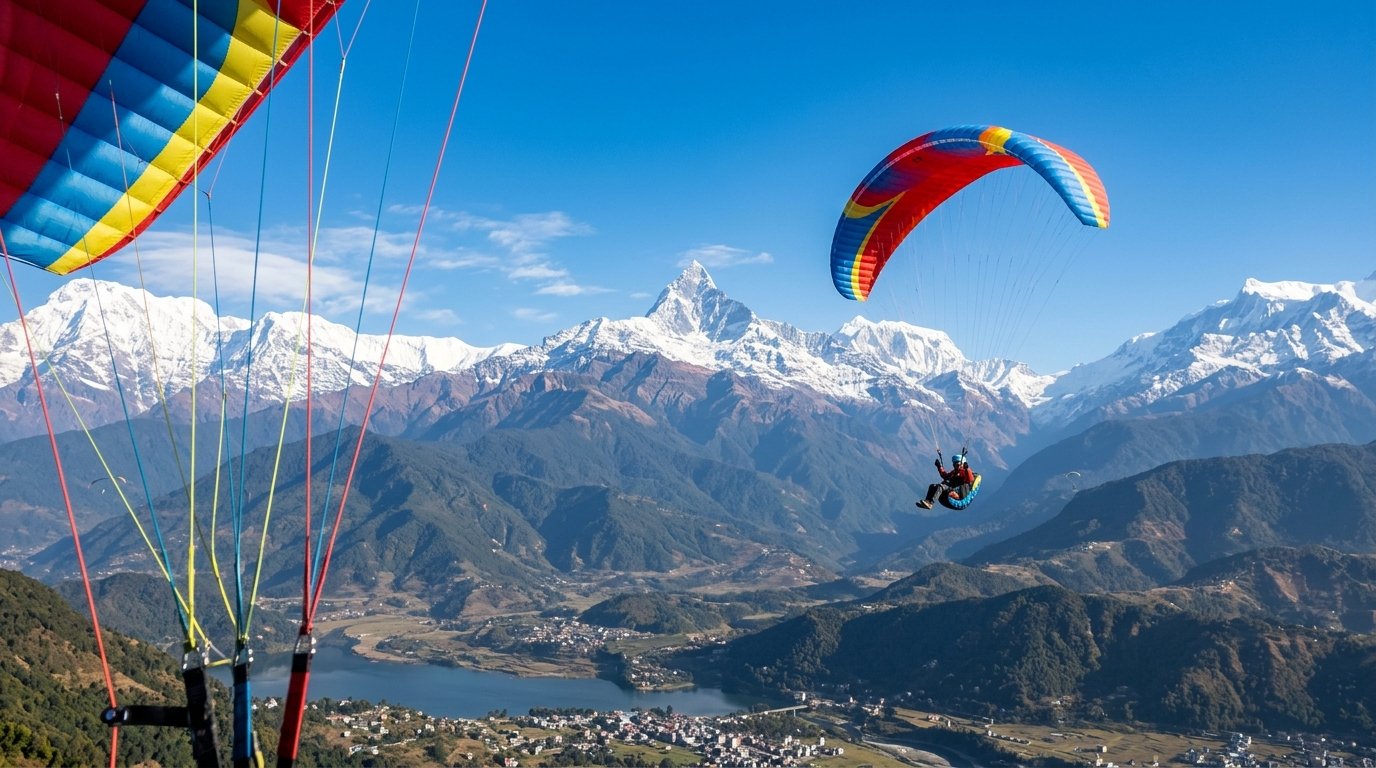
There is a moment, about ninety seconds after running off the edge of Sarangkot hill, when the ground simply stops being relevant. The Pokhara Valley spreads out below in a patchwork of green terraces and rooftops, Phewa Lake catches the morning light like a sheet of hammered silver, and directly ahead, close enough to feel impossibly near, the white wall of the Annapurna range rises into the sky alongside the unmistakable fishtail summit of Machhapuchhre. Nothing in front of you but air. This is paragliding in Pokhara, and it is widely regarded as one of the five best places on earth to do it.
The geography here is close to perfect for the sport. Sarangkot's ridge at 1,592 metres gives a high, reliable launch point. The valley floor generates steady, predictable thermal currents through the morning. Phewa Lake provides a wide, forgiving, hazard-free landing zone. And the backdrop is the Annapurna Himalaya, one of the most photogenic mountain ranges in the world. Add internationally licensed pilots and a well-established safety record, and it is easy to see why this single activity has become one of the most talked-about things visitors do in Nepal.
This guide covers everything you need to plan your flight: how the day unfolds, what it costs, when to go, how safe it is, and how to combine it with the rest of your Pokhara itinerary.
Why Pokhara Is Ranked Among the World's Best
Best Time of Year and Time of Day
Safety Standards and What to Check
Pokhara consistently appears on global lists of the top commercial tandem paragliding destinations, and the reasons are almost entirely down to geography. Sarangkot, the main launch site, sits at 1,592 metres on a ridge above the city, giving pilots a high, open take-off with reliable wind exposure. Beneath it, the valley floor warms quickly in the morning sun, generating the rising thermal currents that keep gliders aloft for twenty to thirty minutes without losing height. Few locations combine a launch this consistent with a landing zone this safe: the wide grassy fields beside Phewa Lake leave no margin for the kind of tricky terrain that complicates paragliding elsewhere.
Then there is the view, which is genuinely unlike anything else available to a first-time flyer anywhere in the world. From the air you see the full sweep of the Annapurna range, Dhaulagiri to the west, and the unmistakable twin-peaked silhouette of Machhapuchhre, all framing a valley of lakes, forested hills, and traditional villages below. Pilots can extend the flight with gentle spirals or acrobatic manoeuvres if you want more adrenaline, or keep it slow and steady if you simply want to take in the scenery. More than 150 tandem flights can take off from Sarangkot on a single peak-season day, a volume that reflects just how dependable the conditions here are.
Most operators collect you from your hotel in Lakeside between 8:30 and 10am, depending on your scheduled flight slot. The drive up to Sarangkot takes around 35 to 45 minutes along a winding hill road, itself a scenic introduction to the morning's adventure. At the top, your pilot runs through a short safety briefing, fits your harness, and checks the wind and thermal conditions before clearing you for take-off.
Tandem paragliding means you are seated in a harness directly in front of an internationally licensed pilot, who controls the glider throughout. No prior experience or training is required. Take-off involves a short run of five to ten steps downhill until the wing catches the air and lifts you both off the ground; from that point on, you simply sit back. The standard flight lasts 20 to 30 minutes, with the option to extend to a 40 to 60 minute cross-country route for an additional fee if you want more time in the air and a longer view of the valley.
Landing takes place on open ground near Phewa Lake, where your pilot guides the glider down to a gentle, running stop, sometimes with the option of a "splash landing" that skims your feet across the lake surface in the final seconds. A return shuttle then takes you back to your hotel, completing a round trip of roughly three hours from pickup to drop-off.
A standard 20 to 30 minute tandem flight in Pokhara costs around NPR 8,500 per person (roughly USD 60 to 90 depending on the exchange rate), and this rate is regulated by the Nepal Airsports Association and applies equally to Nepali, Indian, Chinese, and all international visitors. The price typically includes hotel pickup and drop-off, transport to and from Sarangkot, a certified pilot, insurance, and government taxes.
Photos and video footage of your flight usually cost extra, around NPR 1,000 to 3,000 depending on the package, and most pilots are happy to film with your own GoPro if you bring one. Cross-country flights of 40 to 60 minutes for more experienced or adventurous flyers cost upwards of NPR 12,000. Booking directly with a licensed operator in Lakeside, rather than through a third-party platform, is generally the better-value option. Group bookings can often be arranged with discounts, which works well for families or friends travelling together.
Paragliding operates in Pokhara nearly every day of the year, weather permitting, but the most reliable conditions fall between September and May, spanning autumn, winter, and spring. October and November, just after the monsoon, deliver the clearest skies and the sharpest mountain views, while March to May brings warmer air and excellent visibility before the pre-monsoon haze builds. December to February remains flyable on clear days and tends to have fewer crowds at the launch site.
Within each flying day, late morning is generally considered ideal: by around 10:30 to 11:30am the sun has warmed the valley enough to generate strong, consistent thermals, while the wind is still calm enough for a smooth ride. Early morning flights offer the calmest air and the softest light for photographs, while afternoon flights can be a little bumpier as winds pick up later in the day. If you are travelling during the June to August monsoon, flights are still offered between rain showers, and many operators offer discounted rates in this quieter season.
Paragliding in Pokhara has an excellent overall safety record, built on stable, predictable flying conditions and decades of accumulated pilot experience. The Civil Aviation Authority of Nepal regulates tandem paragliding operations, requiring licensed pilots and certified, regularly inspected equipment. That said, the small number of serious incidents recorded over the years have almost always traced back to unlicensed operators, poorly maintained gear, or a decision to fly despite unsafe wind or weather conditions.
The simplest way to protect yourself is to book only with operators who can show a valid Nepal Airsports Association or CAAN licence, and to trust a pilot who postpones or cancels a flight if conditions look marginal. Reputable companies will never push a flight through bad weather for the sake of a booking. Getaway Nepal Adventure works only with established, licensed paragliding partners in Pokhara who meet these standards, and we are happy to confirm an operator's credentials before you book.
Tandem paragliding in Pokhara is accessible to nearly everyone. Most operators accept flyers from around 5 years old with parental consent up to no defined upper age limit; what matters is general fitness rather than age, since the only physical requirement is being able to run a short distance for take-off. Weight limits typically fall between 20kg and 90 to 100kg depending on the operator and pilot combination.
Mild fear of heights is rarely a barrier, since paragliding feels different from standing on an exposed ledge; the sensation in the air is closer to floating than falling. Health conditions that should be discussed with your operator in advance include heart conditions, severe vertigo, recent surgery, and pregnancy, the last of which is generally not recommended. Beyond that, the activity genuinely suits a wide range of travellers, from young children flying with a parent's consent to retirees in their seventies and eighties enjoying one of the most memorable mornings of their trip.
Paragliding pairs naturally with the rest of Pokhara's adventure scene, and most visitors build it into a wider itinerary around the lakeside town. A sunrise drive to Sarangkot for the mountain panorama works well as a warm-up the morning before or after your flight. For travellers chasing a bigger adrenaline hit, the Hemja bungee jump near Lakeside offers a 70-metre freefall over a gorge just twenty minutes from town, and our full bungee jumping in Nepal guide covers everything you need to know about that and Nepal's other major jump sites.
Pokhara is also the gateway to Nepal's white water rafting scene, with the Trishuli, Seti, and Kali Gandaki rivers all reachable from the city; our white water rafting in Nepal guide breaks down which river suits your experience level. After a few days of paragliding, rafting, and trekking around the Annapurna foothills, many travellers finish their Pokhara stay with a proper recovery session; see our guide to the best massage and spa options in Pokhara after trekking for where to unwind before heading back to Kathmandu.
If your Nepal trip includes an Annapurna trek, paragliding is the perfect closing activity, requiring just one clear morning before or after the trail. See our Annapurna region trekking page to plan the full combination.
How much does paragliding cost in Pokhara?
A standard 20 to 30 minute tandem flight costs around NPR 8,500 (roughly USD 60 to 90) per person, including hotel pickup, transport to Sarangkot, a certified pilot, and insurance. The same rate applies to Nepali and foreign nationals under official regulation.
What is the best time of year for paragliding in Pokhara?
September to May offers the most reliable conditions, with October to November and March to May delivering the clearest skies and best mountain views. Late morning, around 10:30 to 11:30am, is generally the best time of day to fly.
Is paragliding in Pokhara safe?
Yes. Pokhara is ranked among the world's top five commercial tandem paragliding destinations because of its stable thermals and safe lakeside landing zone. Always confirm your operator holds a valid Nepal Airsports Association or CAAN licence before booking.
Do I need any experience to go paragliding in Pokhara?
No. Tandem flights pair you with a certified pilot who controls the glider throughout, so no prior experience or training is required. A short pre-flight briefing covers everything you need to know.
Tell us your travel dates, group size, fitness level, and what you are looking for. We respond within 24 hours with availability and a tailored itinerary.

Getaway Nepal Adventure (P.) Ltd.
Thamel Kathmandu, Nepal
Tel: +977 98510 38 908





 TripAdvisor