Somewhere along the way, Nepal got a reputation as a destination for twenty-somethings with heavy packs and high-altitude ambitions. That reputation is only part of the story - and for older travellers considering their options, it's the part that matters least.
Nepal's greatest treasures are not at 5,000 metres. They are in the medieval courtyards of Bhaktapur, at the golden spires of Boudhanath at dawn, in the sal forests of Chitwan where a one-horned rhino materialises out of the grass, along the lakeside of Pokhara with the Annapurna range filling the northern sky, and at the birthplace of the Buddha in the sacred garden of Lumbini. None of these require a single strenuous uphill step. All of them are accessible by private vehicle, short walks at your own pace, and comfortable hotels with working lifts.
Getaway Nepal Adventure has organised senior-friendly tours in Nepal for over two decades. We have taken travellers in their 60s, 70s, and 80s to places they assumed were beyond them and watched those assumptions dissolve the moment they arrived. This guide shares everything we have learned: what makes Nepal genuinely work for older visitors, how to plan an itinerary that is comfortable rather than exhausting, and what to expect at every step.
Why Nepal Works So Well for Senior Travellers
Best Destinations for Senior Visitors
Sample 10-Day Senior-Friendly Itinerary
How to Pace a Senior Nepal Trip
Accommodation Standards and What to Look For
The first thing to understand about Nepal is its geography. The country's main tourism circuit - Kathmandu, Pokhara, Chitwan, Lumbini - is compact and low-altitude. Kathmandu sits at 1,300m (4,265ft). Pokhara is at 820m. Chitwan National Park is at 415m. Lumbini is in the lowland plains. Distances between them are manageable, and all are connected by short domestic flights (30 to 45 minutes) or scenic road journeys with private vehicles and experienced drivers.
This means a senior traveller in Nepal spends very little time in transit and a great deal of time actually experiencing the country. You can cover four extraordinary destinations in ten days without feeling rushed, and you can adjust the pace of each day to match energy levels.
The second advantage is the density of extraordinary things to see at low altitude. Seven UNESCO World Heritage Sites sit in the Kathmandu Valley alone. Pokhara's lakeside and the Annapurna panorama are accessible from the valley floor. Chitwan offers tigers, rhinos, and elephants by jeep. Lumbini's sacred garden requires nothing more than gentle walking on flat ground between monasteries. Nepal rewards the curious traveller regardless of physical capability - and that is rare.
The third, less quantifiable advantage is how Nepal feels to an older visitor. The country's deep reverence for elders - rooted in both Hindu and Buddhist culture - means that older travellers are genuinely welcomed and respected at every step, by guides, guesthouse owners, temple attendants, and local people in villages. That warmth is real, and it makes a significant difference to the overall experience.
Kathmandu Valley. The cultural heart of Nepal and the starting point for almost every trip. The main sites - Boudhanath Stupa, Pashupatinath Temple, Patan Durbar Square, Bhaktapur Durbar Square, Swayambhunath - are all reachable by private vehicle and involve short, manageable walks on paved or cobblestone surfaces. Experienced guides navigate the most accessible routes, avoiding unnecessary steps or steep sections where alternatives exist. Two to three days here leaves no sense of rush. See our Kathmandu Valley guide for detail on each site.
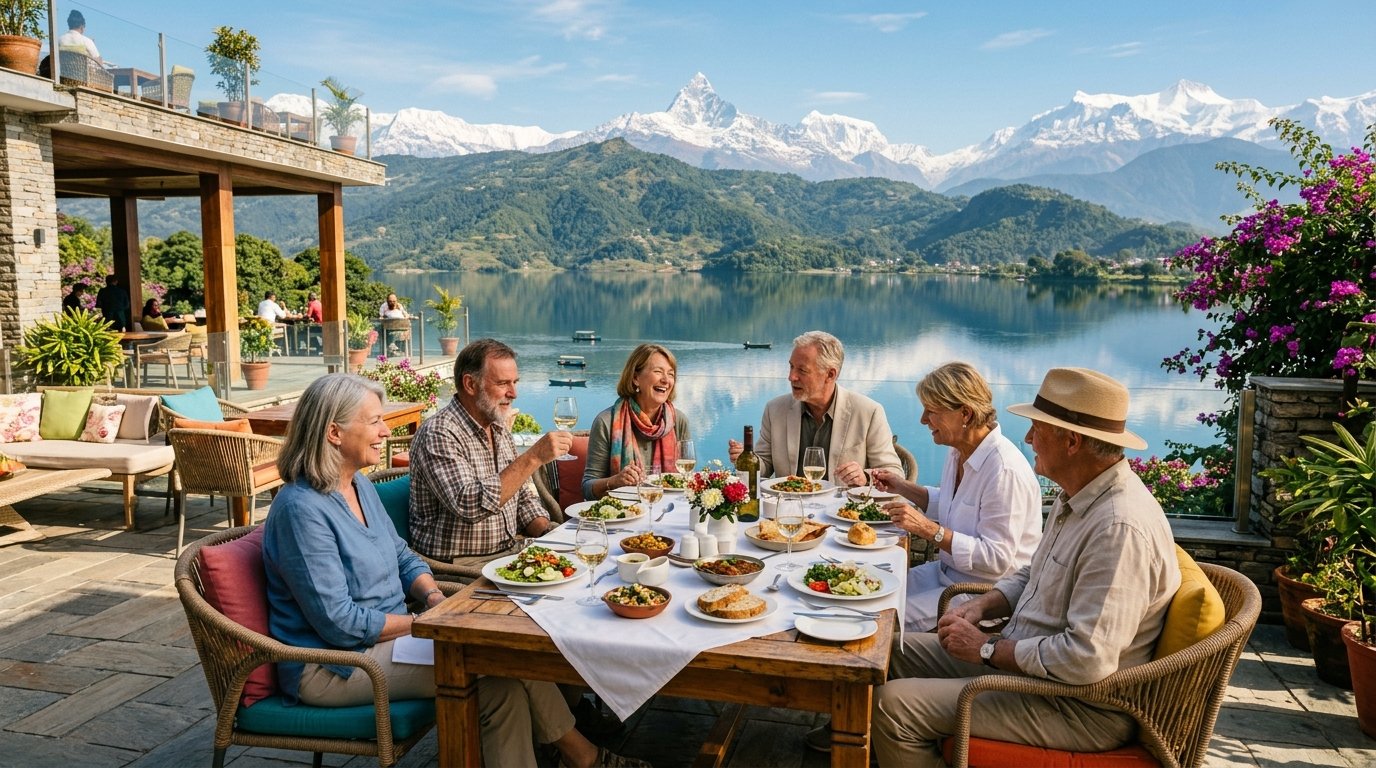
Pokhara. Nepal's second city and, for many senior visitors, the highlight of the trip. The lakeside setting on Phewa Lake with the Annapurna and Machhapuchhre ranges reflected in the water is genuinely one of the most beautiful views in Asia. The lake promenade is flat and peaceful, ideal for leisurely morning or evening walks. A drive to Sarangkot for sunrise over the Himalayas requires no walking at all. A short boat ride on the lake, a visit to the World Peace Pagoda, and the International Mountain Museum fill two comfortable days without physical strain. See our Pokhara Valley guide.
Chitwan National Park. The wildlife experience Nepal offers that most people don't expect. Private jeep safaris through sal forest and grassland, canoe trips on the Rapti River, and Tharu cultural evenings combine into 2 to 3 days of genuine adventure at zero altitude. The heat requires managing in summer months, but October to April is very comfortable. Domestic flights from Kathmandu or Pokhara avoid the road journey entirely. See our Chitwan guide.
Lumbini. The birthplace of the Buddha and one of the most serene destinations in Nepal. The sacred garden with the Maya Devi Temple is flat and peaceful, surrounded by monasteries built by Buddhist nations from around the world - Japanese, Chinese, Thai, Sri Lankan, Korean, each with distinct architecture. For Buddhist and Hindu travellers especially, Lumbini is a deeply moving experience with very gentle physical demands. See our Lumbini guide.
Nagarkot and Dhulikhel. Hill stations 30 to 40km from Kathmandu offering panoramic Himalayan sunrise views from comfortable hotels and resorts. These are excellent for older travellers who want to experience the Himalayan panorama without any trekking - you simply wake up, walk to the hotel terrace, and watch the peaks emerge from the clouds. Dwarika's Resort at Dhulikhel adds world-class wellness facilities to this setting.
Days 1-3: Kathmandu. Arrive and settle into a centrally located hotel with lift access. Day 2: morning visit to Patan Durbar Square and Boudhanath Stupa with a private guide; afternoon rest. Day 3: Pashupatinath Temple at dawn (a genuinely moving experience even for non-Hindus), followed by Bhaktapur Durbar Square in the morning and a free afternoon. Optional Himalayan mountain flight on Day 1 evening or Day 2 morning for instant aerial views of Everest and the main range - 60 minutes, no walking, extraordinary views.
Days 4-5: Nagarkot or Dhulikhel. One night at a hill station hotel for the sunrise panorama experience. Gentle nature walk or simply time on the terrace with tea and the views. Return to Kathmandu on Day 5 with a stop at Changu Narayan Temple on the way.
Days 6-7: Chitwan National Park. Short flight from Kathmandu (35 minutes). Private jeep safari morning and afternoon with an expert naturalist guide. Canoe trip on the Rapti River. Tharu village walk and cultural dance evening. Wildlife at this altitude is outstanding and the activity programme is entirely vehicle- and boat-based.
Days 8-9: Pokhara. Short flight from Bharatpur or direct from Kathmandu. Morning walk along the Phewa Lake promenade. Private boat ride on the lake with Fishtail Mountain reflected in the water. Drive to Sarangkot for the Annapurna panorama. Optional Peace Pagoda visit and International Mountain Museum.
Day 10: Return to Kathmandu. Short flight or scenic road journey. Final afternoon for shopping in Thamel, a cooking class, or a visit to a Tibetan refugee craft centre. Farewell dinner at a rooftop restaurant with Himalayan views.
This itinerary can be extended to 12 days by adding Lumbini (2 nights: fly from Kathmandu, visit the sacred garden and international monasteries, fly back). Contact us at info@getawaynepal.com or browse our Nepal tours for seniors for package options.
Pacing is the single factor that separates a rewarding senior Nepal trip from an exhausting one. The specific destinations matter less than how the days are structured. Getaway Nepal Adventure applies these principles to every senior itinerary we design.
No more than two major sightseeing stops per day. A morning at Boudhanath and an afternoon at Patan is a full and satisfying day. Three or four UNESCO sites in a day is a march, not a visit. Quality of experience goes up significantly when the pace slows down.
Mid-day rest is built in, not optional. Between noon and 2pm, a good hotel room and an hour off your feet makes a meaningful difference to afternoon energy. Our senior itineraries factor this in as standard.
Early starts are avoided unless they are the point. A sunrise at Sarangkot genuinely requires a 5am departure and it is worth it. Most other morning sightseeing is better at 8 or 9am than at 6am, when you have had a proper breakfast and the light is often better anyway.
Flight connections replace long road journeys wherever possible. The drive from Kathmandu to Chitwan takes 4 to 5 hours on winding mountain roads. The flight takes 35 minutes. For senior travellers, the choice is straightforward, and the cost difference is modest relative to the difference in comfort.
Rest days are treated as a feature, not a failure. A day in Pokhara with no scheduled activities - just the lake, a good book, and a long lunch on a terrace - is one of the best days in Nepal. Our itineraries protect this space.
Nepal's hotel stock in Kathmandu and Pokhara has improved significantly. The Hyatt Regency, Marriott, Yak and Yeti, and Hotel Yak and Yeti in Kathmandu all meet international standards with reliable lifts, in-room temperature control, and medical assistance contacts. Boutique heritage properties like Dwarika's Hotel offer exceptional character with the same physical accessibility.
Key things to check for senior travellers: rooms accessible by lift (not only stairs); attached bathrooms with walk-in or low-step shower; in-room temperature control; 24-hour reception; reliable hot water. Getaway Nepal Adventure selects hotels based on direct inspection and regular feedback from senior guests, and we provide specific recommendations for guests with mobility limitations or other physical requirements. Tell us what you need and we will match it.
In Chitwan, quality jungle lodges (Meghauli Serai, Kasara) have cottage accommodation on flat ground with accessible bathrooms. In Pokhara, lake-facing resorts and the Tiger Mountain Pokhara Lodge offer both comfort and extraordinary scenery.
All Getaway Nepal Adventure senior tours use private vehicles with experienced drivers - not shared tourist buses or public transport. Private vehicles mean departure times adapt to the group, stops happen when needed, and luggage is handled at every point. Road quality varies across Nepal, and experienced drivers know which routes are genuinely comfortable and which are best replaced by domestic flights.
Domestic flights within Nepal are short (30 to 45 minutes between main centres), inexpensive relative to the comfort benefit, and operated by reputable carriers including Yeti Airlines and Shree Airlines. We arrange all domestic flights as part of senior tour packages. The one exception is Pokhara International Airport, now operational with improved facilities.
Within Kathmandu, tuk-tuks and rickshaws are optional local experiences for short distances; private vehicles remain the default for all main sightseeing. At sites with steep stairs (the classic example: Swayambhunath's 365 stone steps), we know the alternative vehicle access route to the same platform that bypasses the stairs entirely.
October to November is the most popular and arguably the best window. Post-monsoon skies are clear, temperatures in the Kathmandu Valley are mild (15 to 25°C), mountain views are extraordinary, and the wildlife in Chitwan is active. This is peak season so accommodation books up and prices are higher, but the conditions are reliably good.
March to May is the spring alternative: rhododendrons in bloom throughout the hill stations, warm temperatures, and good visibility before the pre-monsoon haze builds in late April. April is historically the highest-arrival month in Nepal and for good reason.
December to February works well for cultural travel at low altitude. Kathmandu and Pokhara are cool but rarely cold in the valley, Lumbini and Chitwan are warm and pleasant, and tourist numbers drop significantly which means easier access to sites and more personal guide attention. Mountain views can be outstanding on clear winter days.
We generally advise against June to September for senior travellers because of monsoon rainfall, reduced road accessibility, and higher humidity, particularly in the Terai. See also our guide to the best activities for seniors in Nepal for seasonal activity advice.
Is Nepal suitable for senior travellers?
Yes. Nepal's major highlights all sit at low altitude and are accessible by vehicle with short, optional walks. With private transport, realistic pacing, and comfortable hotels, Nepal is an excellent destination for travellers in their 60s, 70s, and beyond. Getaway Nepal Adventure has organised 100+ senior tours and has guests who return year after year.
What is the best time of year for senior travel to Nepal?
October to November and March to May are the ideal windows: stable weather, clear mountain views, and comfortable temperatures. December to February is also viable for cultural travel at low altitude with fewer crowds.
Is there an age limit for Nepal tours?
No official age limit exists for Nepal tourism. Getaway Nepal Adventure has arranged tours for travellers well into their 80s. The key is itinerary design - choosing low-altitude destinations, building in rest time, using private transport, and keeping daily activities realistic and enjoyable.
What if someone in the group needs medical attention in Nepal?
Kathmandu has CIWEC Clinic and several international-standard hospitals specifically experienced in treating tourists. Pokhara also has good medical facilities. Our guides carry basic first aid equipment and know which facilities to contact for any emergency. We always recommend comprehensive travel insurance including medical evacuation cover before travel.
Tell us your travel dates, group size, mobility preferences, and any health considerations. We respond within 24 hours with availability and a fully tailored itinerary designed around your comfort.

Getaway Nepal Adventure (P.) Ltd.
Thamel Kathmandu, Nepal
Tel: +977 98510 38 908





 TripAdvisor