Most people's mental image of Nepal involves a backpack, a teahouse, and a long queue at Everest Base Camp. That picture is accurate for one kind of Nepal trip - but not the only kind. For travellers accustomed to a certain standard of experience, there is a completely different Nepal available.
Nepal has a genuinely impressive luxury travel infrastructure: heritage hotels in Kathmandu with centuries-old Newari woodwork and Michelin-quality restaurants, mountain lodges with en-suite bathrooms and fireplaces overlooking 8,000-metre peaks, private helicopter access to glaciers and remote valleys, luxury tented camps in Chitwan and Bardia with river-facing decks, and wellness retreats in the Himalayan foothills running Ayurvedic programmes. The country's natural and cultural endowment is extraordinary. The service standards, at the top end, match or exceed comparable properties in Bali, Sri Lanka, or East Africa - at prices that still represent genuine value.
Helicopter and Private Air Experiences
Cultural and Heritage Experiences
Luxury travel in Nepal is defined by the quality of the experience - how privately you experience it, how knowledgeable your guide is, how good the food is relative to where you are eating it, and how much of the logistical friction has been removed so you can simply pay attention to what is in front of you.
In practical terms, a luxury Nepal trip means: accommodation in 4-star and 5-star properties or the equivalent in boutique heritage and mountain lodge categories; private licensed guides who adapt each day to your pace and interests; private transfers in quality vehicles; and the option to upgrade specific experiences - a helicopter to Everest Base Camp instead of the two-week trek, a private chef dinner overlooking Kathmandu Durbar Square, a sunrise yoga session on a Himalayan lodge deck.
What Nepal does not offer is a generic luxury product. The experience is inherently specific to this place, these mountains, this culture. That specificity is exactly what makes it worth choosing over another overwater bungalow resort.
Kathmandu Heritage Hotels. Dwarika's Hotel is the benchmark: a living museum of 15th to 17th century Newari woodwork, with the Krishnarpan Restaurant serving 22-course tasting menus of Nepali cuisine, and a spa rooted in Ayurvedic and Himalayan traditions. It is one of the most distinctive luxury hotels in Asia. The Hyatt Regency and Marriott provide international-chain reliability with mountain views and garden settings.
Mountain Lodge Category. The Everest View Hotel above Namche Bazaar (3,880m) is one of the most dramatically located hotels on earth. Shinta Mani Mustang in Upper Mustang represents a new generation of expedition lodges: sustainable design, extraordinary location, and total immersion in one of Nepal's most remote valleys. Tiger Mountain Pokhara Lodge offers hilltop seclusion with panoramic Annapurna views.
Wellness and Retreat Properties. Dwarika's Resort in Dhulikhel offers the same heritage pedigree as the Kathmandu property with a full Himalayan wellness programme, Ayurvedic consultations, and an infinity pool overlooking 13 Himalayan peaks. The Pavilions Himalayas near Pokhara combines private villas, an organic farm, and genuine wellness programming.
Jungle Lodges. Meghauli Serai (a Taj property) in Chitwan and similar luxury camps in Bardia deliver the wildlife safari experience with en-suite tents or cottages, excellent food, expert naturalist guides, and sunset drinks on a river deck. See our full luxury wildlife safari guide.
The standard Nepal trek stays in basic teahouses with shared bathrooms and dal bhat for dinner. The luxury version stays in private lodge rooms with attached bathrooms, has a private guide adapted to your pace, has a porter for every member of the group, eats meals prepared to dietary preferences, and has the option to helicopter out from any point on the route.
The Everest region's luxury lodge infrastructure has improved substantially. The Khumbu Luxury Lodge, Yeti Mountain Home, and similar premium properties in Namche Bazaar and Dingboche now offer genuinely comfortable rooms, hot showers, and decent wine. Annapurna Sanctuary approaches have a similar upper tier. Upper Mustang, particularly around Lo Manthang, has quality guesthouses for a region this remote.
For a full breakdown of options and routes, see our dedicated luxury trekking in Nepal guide.
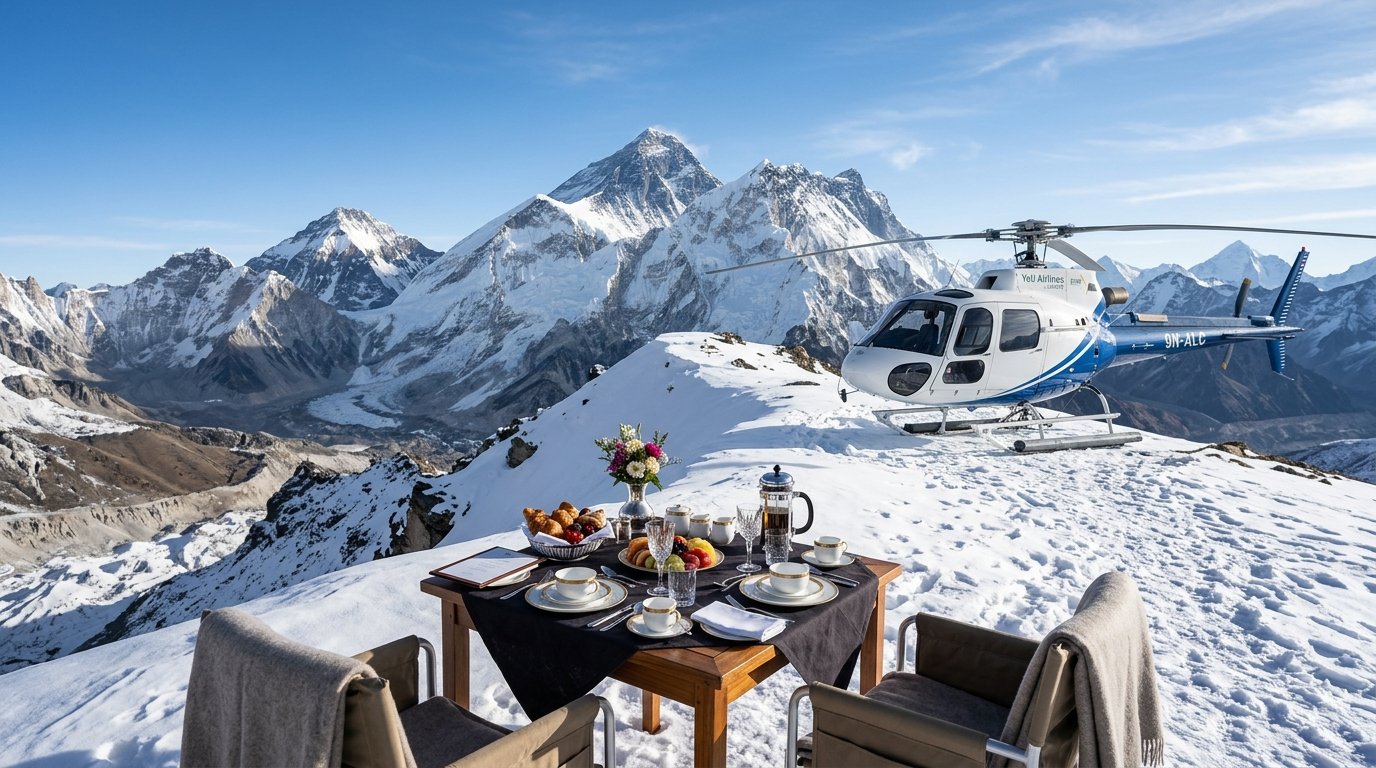
The helicopter is what gives Nepal's luxury travel market its most distinctive experiences. You can fly to Everest Base Camp from Kathmandu in 90 minutes, land on a glacier, have breakfast at 5,300m, and be back in time for lunch. You can fly from Pokhara to Annapurna Base Camp in 20 minutes. You can access Upper Mustang's ancient walled city of Lo Manthang in 45 minutes from Pokhara rather than a week of trekking.
Private helicopter charters are available from Kathmandu and Pokhara through licensed operators. A typical Everest Base Camp helicopter tour with breakfast runs from USD 1,000 to 1,400 per person depending on group size. Private charter of the full aircraft provides complete flexibility on timing and landing points.
Nepal has two serious wildlife safari destinations: Chitwan National Park and Bardia National Park. Both have Bengal tigers, one-horned rhinos, elephants, and exceptional birdlife. Bardia is wilder and far less visited with a higher chance of remote, uncrowded encounters. Chitwan has better luxury lodge infrastructure.
At the premium end, the quality of the lodge experience is genuinely high: private jeep safaris, walking safaris with armed rangers, canoe trips on Nepal's river systems, and evening Tharu cultural programmes. A 3 to 5 day safari is a significant component of any Nepal luxury itinerary. See our full luxury Nepal wildlife safari guide.
Nepal's wellness credentials are genuine rather than manufactured. The country is Buddhist and Hindu at its core; practices like meditation, yoga, Ayurveda, sound healing, and breathwork have been practised in the Himalayan region for centuries. Retreats here draw on that depth in ways that a purpose-built spa resort elsewhere cannot.
Dwarika's Resort at Dhulikhel runs structured wellness programmes including Ayurvedic consultations, panchakarma treatments, yoga with experienced practitioners, guided meditation, and farm-to-table organic cuisine - all set against 13 Himalayan peaks visible from the retreat grounds. For travellers combining active and restorative experiences, a Nepal trip structured around 2 to 3 days in a wellness retreat, 4 to 5 days trekking, and 2 to 3 days cultural sightseeing makes for a genuinely balanced journey. See our full wellness retreat guide.
Kathmandu's UNESCO World Heritage Sites are accessible to anyone. What separates a luxury cultural experience is access and depth: a private guide who is a specialist in Newari art and architecture; early-morning access to Pashupatinath before the crowds; a private courtyard dinner in a restored medieval Newari merchant's house; a monastery visit that includes time with the abbot.
For travellers interested in living Tibetan Buddhist culture, Upper Mustang is in a completely different category. The medieval walled city of Lo Manthang, its four active monasteries, and the extraordinary plateau landscape represent a cultural encounter that cannot be replicated anywhere else. Access via our helicopter tour or the Tiji Festival trek.
Days 1-3: Kathmandu. Heritage hotel (Dwarika's or equivalent). Private guided cultural tours of Patan, Bhaktapur, and Boudhanath. Sunset rooftop dinner. Early morning Pashupatinath visit. Optional mountain flight at dawn.
Days 4-6: Pokhara and Annapurna. Tiger Mountain Lodge or Pavilions Himalayas. Optional helicopter to Annapurna Base Camp on Day 4. Lakeside exploration and sunrise at Sarangkot. Wellness session at the lodge spa.
Days 7-9: Chitwan or Bardia. Luxury jungle lodge. Morning and afternoon jeep safaris for tigers, rhinos, and elephants. River canoe trip. Tharu village and cultural evening. Watchtower wildlife session.
Day 10: Return to Kathmandu. Farewell dinner at Krishnarpan Restaurant, Dwarika's. Departure.
Variations available: replace Chitwan with Bardia for wilder wildlife; add Upper Mustang by helicopter from Pokhara; extend trekking days for an Everest View Hotel stay. Contact us at info@getawaynepal.com for a bespoke version. See also our guides to best luxury hotels in Nepal.
Is Nepal a good destination for luxury travel?
Yes. Nepal combines world-class Himalayan scenery, extraordinary cultural heritage, premium lodge accommodation, private helicopter access, and authentic experiences impossible to replicate at more crowded destinations. It remains significantly better value than comparable experiences in Europe or the Maldives.
What does a luxury Nepal tour typically cost?
Land-only packages for a 10-day luxury Nepal tour start from around USD 3,500 to 5,000 per person depending on accommodation tier, helicopter use, and group size. International flights are additional.
What is the best time for a luxury trip to Nepal?
October to November and March to May offer the clearest skies and best mountain views. December and January are quieter with similarly clear weather. The monsoon (June to September) is viable in Upper Mustang, which sits in the Himalayan rain shadow.
Do I need a visa for Nepal?
Most nationalities can obtain a visa on arrival at Tribhuvan International Airport in Kathmandu. The standard tourist visa costs USD 30 for 15 days, USD 50 for 30 days, or USD 125 for 90 days. An e-Visa can be obtained online before travel.
Tell us your travel dates, group size, and what you are looking for. We respond within 24 hours with availability and a tailored itinerary.

Getaway Nepal Adventure (P.) Ltd.
Thamel Kathmandu, Nepal
Tel: +977 98510 38 908





 TripAdvisor